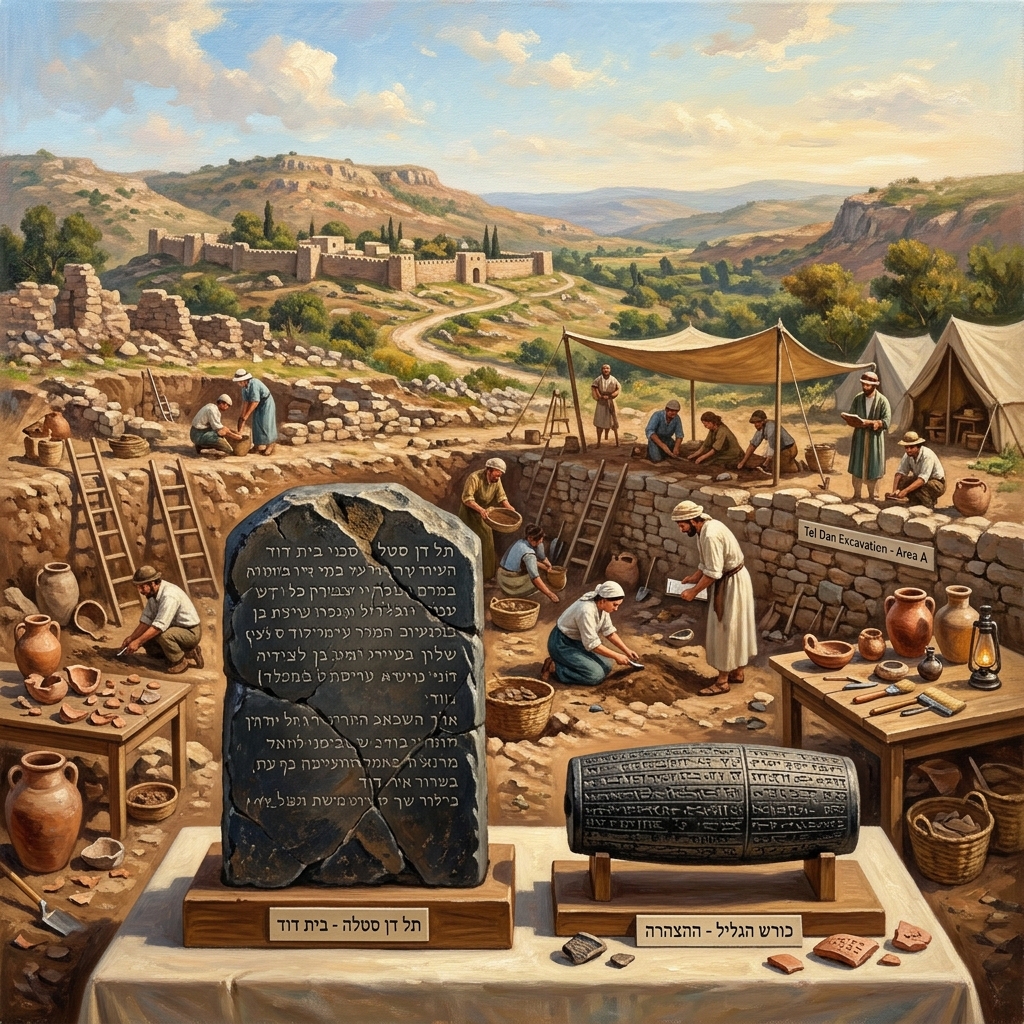
For centuries, skeptical historians questioned whether the figures and places described in the Bible were historical realities or mythic inventions. However, over the past 150 years, spade and trowel have repeatedly brought buried biblical history into the light. Biblical archaeology does not attempt to prove faith, but it firmly grounds the biblical narrative in real geography, real chronology, and real stone inscriptions.
Here are seven of the most significant archaeological discoveries that confirmed key people, places, and events recorded in the scriptures.
1. The Tel Dan Stele (Discovered 1993)
For decades, critics argued that King David was a mythical figure created by later Jewish writers. That consensus shattered in 1993 at Tel Dan in northern Israel, where archaeologists discovered an 9th-century BC basalt inscription erected by Hazael, King of Aram-Damascus.
The inscription boasts of defeating Israelite kings and explicitly references the **"House of David"** (*Bytdwd*). This marked the first non-biblical historical reference to the Davidic dynasty, establishing David as a real historical king.
2. The Pilate Inscription (Discovered 1961)
Prior to 1961, no contemporary Roman inscription had ever been found bearing the name of Pontius Pilate, the Roman governor who condemned Jesus to crucifixion. Critics suggested Pilate might be a legendary character created by the Gospel writers.
In 1961, Italian archaeologists excavating the Roman theater at Caesarea Maritima discovered a limestone block carved with a Latin dedication: *"Pontius Pilatus, Prefect of Judea."* The inscription confirmed Pilate's exact historical title and administrative presence in Judea during the reign of Tiberius Caesar.
3. The Dead Sea Scrolls (Discovered 1947–1956)
Discovered by Bedouin shepherds in caves near Qumran near the Dead Sea, the Dead Sea Scrolls represent the greatest manuscript discovery of the 20th century. Hidden by the Essenes before Jerusalem fell to Rome in AD 70, the manuscripts included parts of every Old Testament book except Esther, dating back 1,000 years earlier than any previously known Hebrew texts.
Comparing the Qumran scrolls with modern Hebrew Bibles proved the astonishing, word-for-word accuracy of Jewish scribal preservation across centuries.
4. The Cyrus Cylinder (Discovered 1879)
In Ezra 1:1-4, the Bible records that Cyrus the Great, King of Persia, issued a royal decree permitting exile populations in Babylon to return to their homelands and rebuild their temples. Critics viewed this decree as Jewish propaganda.
In 1879, British excavators in Babylon uncovered a clay barrel inscription known as the Cyrus Cylinder. Written in cuneiform, the cylinder records Cyrus' official policy of repatriating displaced peoples and restoring their native sanctuaries, confirming the biblical narrative in Ezra and Isaiah.
5. The Caiaphas Ossuary (Discovered 1990)
In 1990, construction workers in southern Jerusalem accidentally breached an ancient burial cave containing ornate limestone bone boxes (*ossuaries*). One elaborate box bore the Aramaic inscription: **"Joseph, son of Caiaphas."**
Anthropological and historical analysis confirmed this was the burial vault of Caiaphas, the Jewish High Priest who presided over the trial of Jesus (Matthew 26:57).
6. The Siloam Tunnel Inscription (Discovered 1880)
In 2 Kings 20:20, the Bible records that King Hezekiah constructed an underground aqueduct to bring water into Jerusalem to withstand an impending Assyrian siege. In 1880, a young boy wading through the underground channel in Jerusalem discovered an 8th-century BC Paleo-Hebrew inscription carved into the tunnel wall, recording how two teams of miners dug from opposite ends and met in the middle.
7. The Pool of Bethesda (Discovered 1888)
In John 5:2, the Gospel mentions a pool near the Sheep Gate in Jerusalem named Bethesda, surrounded by "five covered colonnades." For centuries, skeptics claimed John made up the location because no such five-porched pool existed. Excavations near St. Anne's Church in Jerusalem uncovered a massive double-pool complex with five distinct porticos exactly matching John's description.