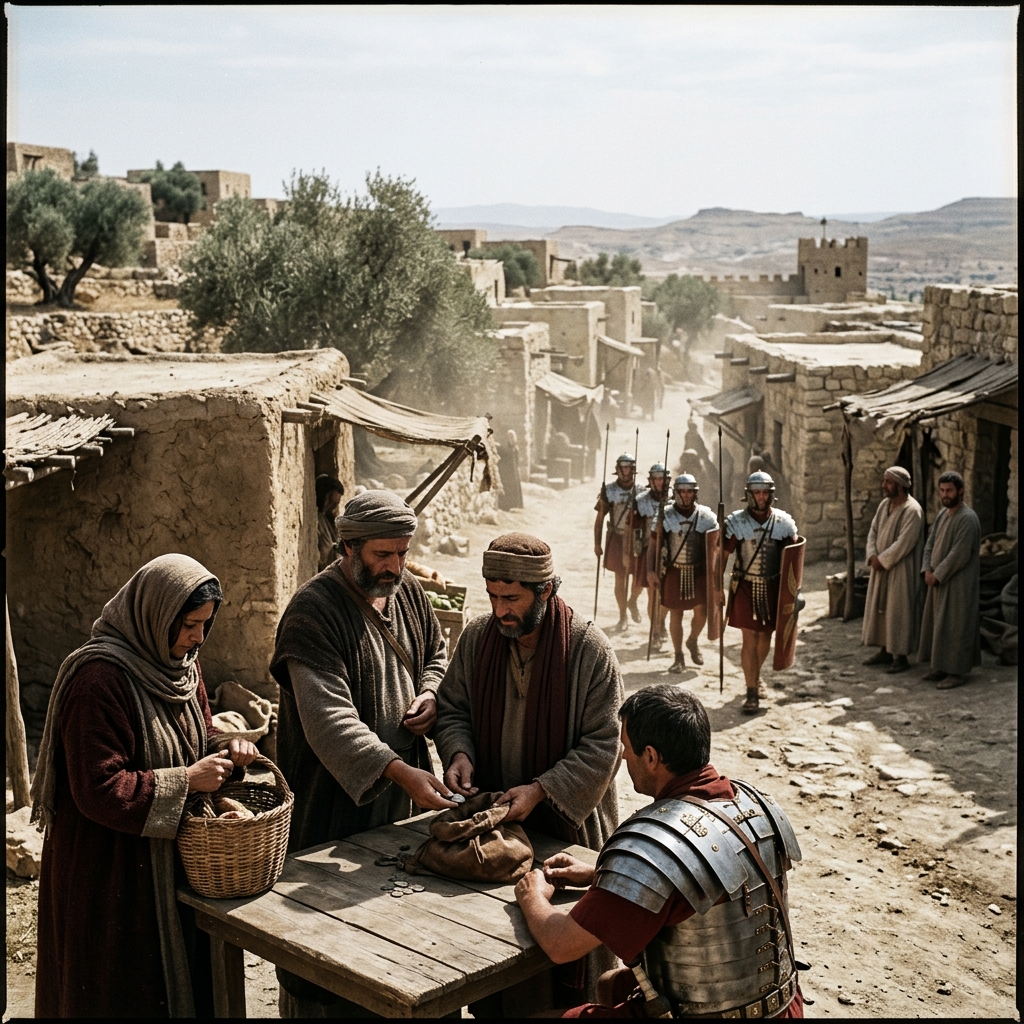
Modern readers often unconsciously project twenty-first-century middle-class values onto the pages of the Bible. But to truly understand the teachings of Jesus, we have to strip away our sanitized worldview and step into the gritty reality of first-century Judea—a primarily agrarian society operating under the crushing weight of the Roman military machine.
The Illusion of the Pax Romana
During the first century, the Mediterranean world was living under the Pax Romana (the "Roman Peace"). Rome boasted that it had brought unprecedented peace and stability to the known world. However, for the Jewish peasants in Judea and Galilee, this "peace" was maintained at the tip of a spear. It was a peace achieved through total military subjugation and brutal pacification.
Roman soldiers were a constant, visible presence. They had the legal right to compel any non-Roman citizen to carry their heavy gear for one Roman mile (which gives radical new context to Jesus' command in Matthew 5:41 to "go with them two miles"). Furthermore, the threat of execution was omnipresent. Crucifixion was not merely a method of capital punishment; it was a psychological weapon designed specifically for slaves and rebels. Rome erected crosses along major highways at eye level so that the general population could look into the dying eyes of the crucified, sending a horrifying message: This is what happens when you defy Rome.
The Crushing Burden of Taxation
Economics in the ancient world were brutal, and taxation in Judea was particularly severe because the Jewish people were essentially taxed twice. First, they were subjected to a litany of Roman taxes: land taxes, head taxes (the census tax), and heavy tolls on goods moving across regional borders. These taxes were collected by local contractors known as publicans (or tax collectors), who were notoriously corrupt and viewed as absolute traitors by their fellow Jews.
Secondly, the Jewish people were required to pay the half-shekel Temple tax to maintain the sacrificial system in Jerusalem, alongside tithes of their agricultural produce. Between Roman tribute and religious obligations, historians estimate that a first-century Judean farmer lost anywhere from 30% to 50% of his annual yield to taxation. This economic desperation forms the backdrop for countless parables regarding crushing debt, ruthless creditors, and day laborers waiting in the marketplace for a single denarius to feed their families.
The Agrarian Economy
First-century Israel was not a society of professionals or middle-class merchants; it was overwhelmingly agrarian. Over 80% of the population lived in small, rural villages and subsisted on farming and fishing. Wealth was entirely concentrated at the top, mostly among the Herodian royal family and the Sadducean aristocracy in Jerusalem.
This agrarian reality profoundly shaped the language of the New Testament. When Jesus taught, he did not use abstract philosophical terminology. He spoke the language of the dirt: sowing seeds, pulling weeds, pruning vines, herding sheep, and catching fish. To the original audience, these were not just quaint metaphors; they were the immediate, sweat-soaked realities of daily survival.
The Temple as the Central Bank
While we often think of the Jerusalem Temple purely as a place of worship, it was actually the economic epicenter of Judea. Because Jewish law required sacrifices of unblemished animals, and because Roman currency bearing the Emperor's image could not be used to pay the Temple tax, a massive industry of money changers and livestock merchants set up shop in the Court of the Gentiles.
The High Priestly family essentially ran a monopoly on the exchange rates and the certification of sacrificial animals. The Temple treasury functioned as the central bank of the nation, holding vast sums of wealth and the debt records of the peasantry. When Jesus overturned the tables of the money changers, he was not just making a point about reverence; he was directly attacking the corrupt economic nerve center of the entire nation.