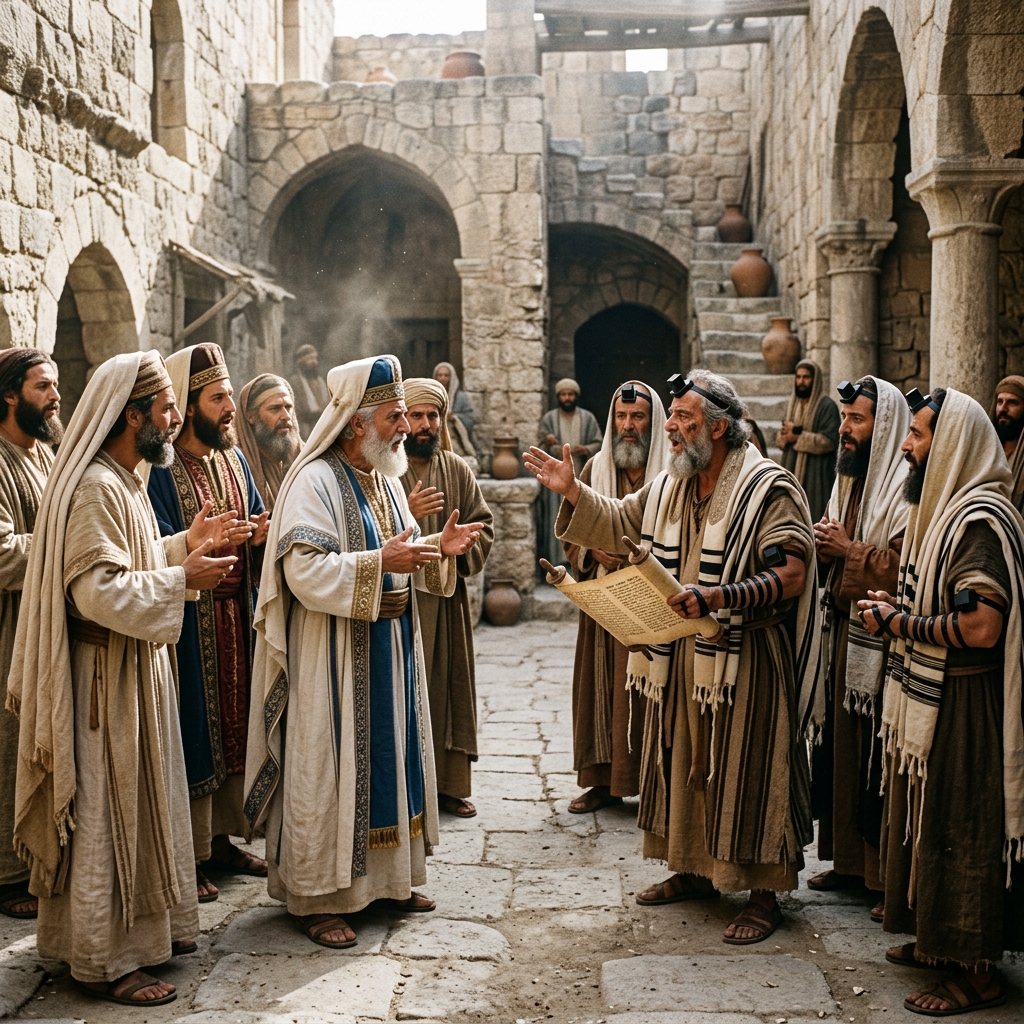
When reading the Gospels, it is easy to mistakenly view the Jewish leaders as a unified front against Jesus. In reality, first-century Judea was a fractured, highly partisan society. The religious and political landscape was divided into four distinct factions: the Pharisees, the Sadducees, the Essenes, and the Zealots. Each group held deeply incompatible views on theology, politics, and how to deal with the Roman occupation.
The Sadducees: The Aristocratic Elite
The Sadducees were the political and religious elite. Composed largely of wealthy aristocrats and high-ranking priests, they controlled the Jerusalem Temple and held the majority of seats on the Sanhedrin (the Jewish high court). Because their wealth and power depended entirely on maintaining the status quo, the Sadducees were staunch pragmatists who collaborated openly with Rome.
Theologically, the Sadducees were strict literalists. They only recognized the authority of the written Torah (the first five books of Moses) and entirely rejected oral traditions. Most notably, they denied the existence of the afterlife, angels, and the bodily resurrection—doctrines they viewed as recent theological inventions. When they challenged Jesus regarding the resurrection (Matthew 22:23), it was not a random theological riddle; it was a targeted attack based on their core platform.
The Pharisees: The Populist Purists
If the Sadducees were the elite establishment, the Pharisees were the populist conservatives. They emerged during the Maccabean era as a grassroots movement deeply committed to personal piety and strict adherence to the Law. Unlike the Sadducees, the Pharisees believed the Oral Law (the traditions of the elders) held equal weight with the written Torah, effectively creating thousands of micro-regulations for daily living.
The Pharisees were incredibly popular among the common people. They controlled the local synagogues and fiercely opposed Hellenism and Roman assimilation. They passionately believed in the resurrection of the dead, angels, and the coming Messiah. Jesus actually aligned with the Pharisees on almost every major theological point, which is precisely why their clashes were so intense. Jesus condemned their hypocrisy and legalism—their tendency to prioritize external purity over internal justice—but he never attacked their core theology.
The Essenes: The Apocalyptic Separatists
Disgusted by the corruption of the Sadducean priesthood and the legalism of the Pharisees, the Essenes chose a radical alternative: isolation. They believed the Jerusalem Temple had been hopelessly defiled. In response, they withdrew to remote desert communities, most famously at Qumran near the Dead Sea, to live lives of extreme asceticism and ritual purity.
The Essenes were apocalyptic survivalists. They believed the end of the world was imminent and that God would soon initiate a massive cosmic war between the "Sons of Light" and the "Sons of Darkness." While they are never explicitly named in the New Testament, their obsessive preservation of scripture gave the modern world the Dead Sea Scrolls, one of the greatest archaeological discoveries in human history.
The Zealots: The Militant Revolutionaries
The Zealots agreed with the Pharisees theologically but took their political resistance to a violent extreme. They believed that paying taxes to Rome was an act of treason against God, the true king of Israel. Their solution to the Roman occupation was not prayer or isolation, but armed guerrilla warfare and assassination.
One of Jesus' own disciples, Simon the Zealot, belonged to this movement. The fact that Jesus called both a Zealot (who hated Rome) and Matthew the tax collector (who worked for Rome) into his inner circle highlights the radical, barrier-breaking nature of his ministry. The Zealots eventually sparked the First Jewish-Roman War, which ended in the catastrophic destruction of Jerusalem and the Temple in AD 70.
Why the Factions Matter
Understanding these four factions fundamentally changes how we read the New Testament. When Jesus taught, he was navigating a political minefield. He refused the Sadducees' compromise, condemned the Pharisees' legalism, ignored the Essenes' isolation, and rejected the Zealots' violence. Instead, he offered a completely different vision of the Kingdom of God—one not built on power, purity, or swords, but on radical grace and self-sacrificial love.