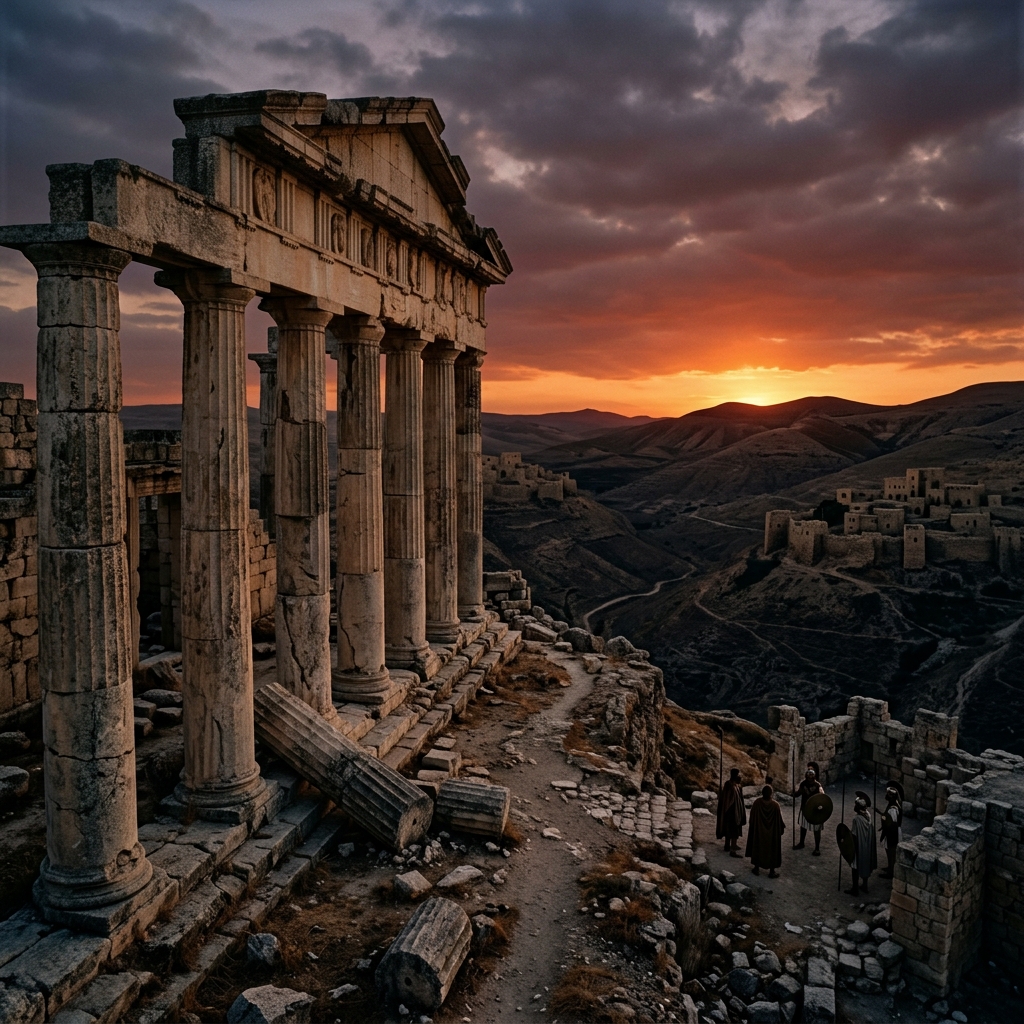
Between the final prophecies of the Old Testament and the opening pages of the New Testament, approximately 400 years passed. Because there is no canonical Protestant scripture recorded during this era, it is frequently referred to as the "Silent Years." However, from a historical and geopolitical perspective, this period was anything but silent. It was a cauldron of military conquest, cultural revolution, and intense religious persecution that perfectly set the stage for the arrival of the Messiah.
The Rise of Hellenism and Alexander the Great
In 332 BC, Alexander the Great swept through the Near East, dismantling the Persian Empire that had previously allowed the Jewish people to return from the Babylonian exile. Alexander's goal was not merely military conquest; he intended to unify the world under Greek culture, a process known as Hellenization. This meant the introduction of Greek philosophy, architecture, and most importantly, the Greek language (Koine Greek).
This linguistic shift was monumental. Within a century, Greek became the lingua franca of the ancient world. It is the reason the New Testament was later written in Greek rather than Hebrew or Aramaic, allowing the Gospel to spread rapidly across the Mediterranean without the barrier of translation. During this period, the Hebrew scriptures themselves were translated into Greek in Alexandria, Egypt—a translation known as the Septuagint (LXX), which became the primary Bible used by the early church.
The Maccabean Revolt and the Abomination of Desolation
Following Alexander's death, his empire fragmented. Judea eventually fell under the control of the Seleucid Empire. In 167 BC, the Seleucid king Antiochus IV Epiphanes initiated a brutal campaign to eradicate Judaism. He outlawed circumcision, burned Torah scrolls, and committed the ultimate sacrilege: he erected an altar to Zeus in the Jerusalem Temple and sacrificed a pig on it.
This horrific event, echoing the prophecies of Daniel regarding the "abomination that causes desolation," sparked a fierce guerrilla war led by a priestly family known as the Maccabees. Against impossible odds, the Jewish rebels recaptured Jerusalem in 164 BC and cleansed the Temple (an event celebrated today as Hanukkah). This victory established the Hasmonean Dynasty, giving Judea a brief century of political independence before the Romans arrived.
Daniel's Timelines and Messianic Expectations
The trauma of the Seleucid persecution and the subsequent Roman occupation caused a massive resurgence in the study of apocalyptic literature, particularly the Book of Daniel. Daniel's visions detailed the successive rise and fall of four great empires—Babylon, Persia, Greece, and Rome—before the God of Heaven would establish an eternal kingdom.
Furthermore, Daniel 9 contained a highly specific timeline (the "seventy weeks") predicting when the "Anointed One" (the Messiah) would appear. By the first century, Jewish scholars and commoners alike were acutely aware that this prophetic countdown was expiring. This explains the fever pitch of messianic expectations visible in the Gospels. The crowds flocking to John the Baptist were not simply seeking a moral teacher; they were looking for a literal, political king who would crush the Roman eagle just as the Maccabees had crushed the Greeks.
Modern Church Application
When modern readers skip straight from Malachi to Matthew, they miss the intense political and theological pressure cooker of first-century Judea. Understanding the Intertestamental Period clarifies exactly why the crowds wanted to take Jesus by force and make him a military king (John 6:15), and why his refusal to lead a violent revolt against Rome ultimately led to his execution.
The "Silent Years" were the crucible in which God prepared the world: a universal language to carry the message, a Roman road system to deliver it, and a desperate, waiting people looking for the promised deliverer.