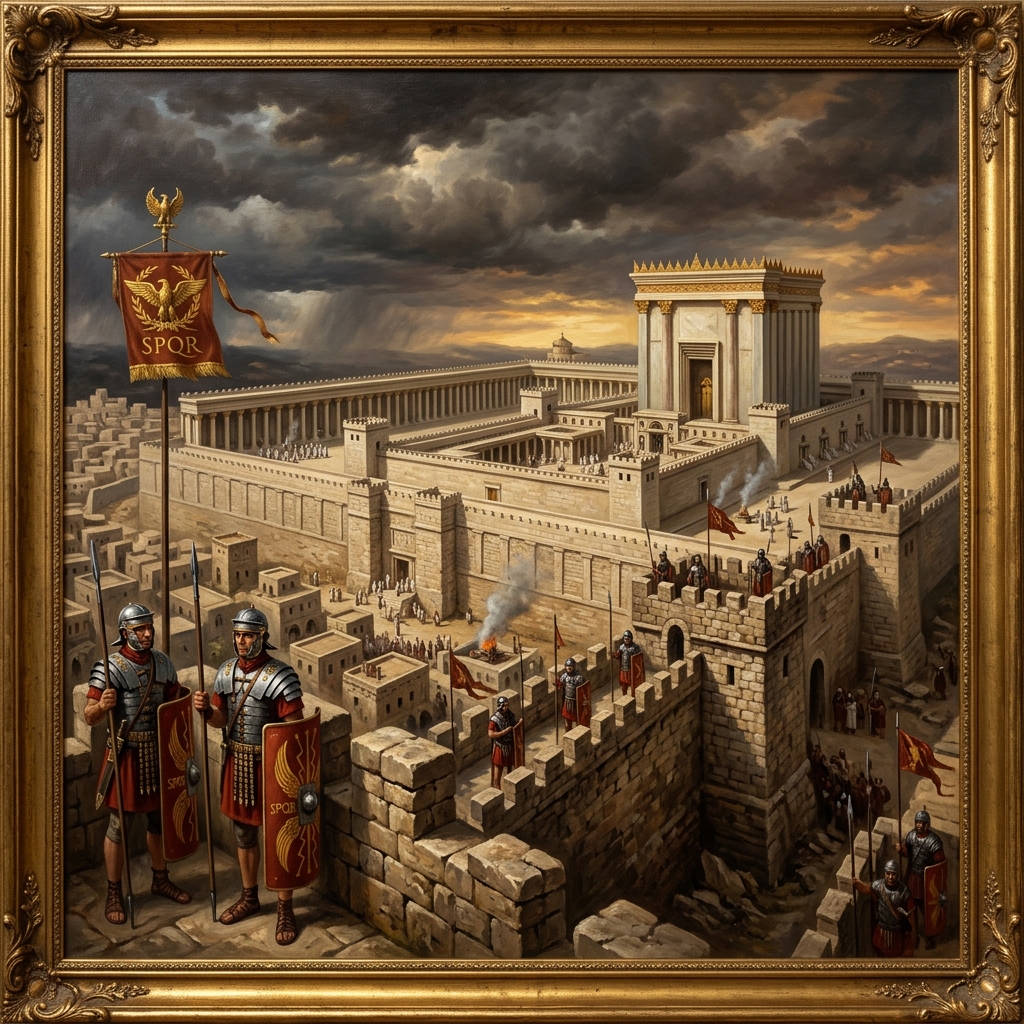
When reading the New Testament, casual readers often assume that "Herod" refers to a single individual. In reality, the name belongs to a ruthless, complex royal family that ruled Judea, Galilee, and surrounding territories under Roman authority for over a century. The Herodian dynasty was defined by paranoid bloodshed, grand architectural ambitions, and intense political maneuvering with Rome.
Understanding which Herod is on the throne in any given passage unlocks the political background of the Gospels and the Book of Acts.
1. Herod the Great (Ruled 37–4 BC)
The founder of the dynasty was Herod I, an Idumean (Edomite) who secured the title "King of the Jews" from the Roman Senate. Because he was not of Davidic lineage, the Jewish population viewed him as a Roman puppet and an outsider.
Herod was a megalomaniacal master builder. To appease his Jewish subjects and cement his legacy, he initiated the massive expansion of the Second Temple in Jerusalem (Herod's Temple), turning it into one of the architectural wonders of the ancient world. He also constructed the fortress city of Caesarea Maritima, the desert palaces of Masada and Herodium, and the fortress of Antonia.
However, Herod was intensely paranoid. He executed his favorite wife (Mariamne), several of his sons, and his mother-in-law to eliminate potential rivals to his throne. This ruthless paranoia forms the exact backdrop for Matthew 2:1-18, where Herod orders the Massacre of the Innocents in Bethlehem upon hearing rumors of a newborn "King of the Jews."
2. Herod Antipas (Tetrarch 4 BC–AD 39)
Upon Herod the Great's death, Rome divided his kingdom among three of his surviving sons. Herod Antipas became the ruler (*tetrarch*) of Galilee and Perea.
Antipas is famous for two major Gospel events. First, he illegally married his brother Philip's wife, Herodias. When John the Baptist publicly condemned this incestuous union, Antipas imprisoned and eventually executed him at the fortress of Machaerus (Mark 6:14-29).
Secondly, when Jesus was arrested, Pontius Pilate sent him to Antipas for questioning because Jesus was a Galilean. Luke 23:8-12 records that Antipas had long wanted to see Jesus perform a miracle; when Jesus refused to answer his questions, Antipas mocked him, dressed him in a royal robe, and sent him back to Pilate.
3. Herod Agrippa I (Ruled AD 41–44)
The grandson of Herod the Great, Herod Agrippa I, managed to reunite most of his grandfather's territory through his personal friendship with Roman emperors Caligula and Claudius.
In Acts 12, Agrippa launched a campaign to win favor with the Jerusalem religious establishment by persecuting the early Christian church. He executed James, the brother of John, with the sword and arrested Peter. Acts 12:20-23 records Agrippa's dramatic death in Caesarea: when the crowd praised him as a god, he failed to give praise to God and was struck down, dying of a horrific intestinal affliction.
4. Herod Agrippa II (Ruled AD 50–100)
The last major ruler of the dynasty, Herod Agrippa II, was the son of Agrippa I. He ruled client territories in northern Palestine and oversaw the appointment of Jewish High Priests.
In Acts 25-26, the Apostle Paul delivered his famous defense before Agrippa II and the Roman governor Festus in Caesarea. Paul appealed to Agrippa's knowledge of Jewish scriptures, famously asking, "King Agrippa, do you believe the prophets? I know you do." Agrippa replied with the famous words, "Do you think that in such a short time you can persuade me to be a Christian?" Agrippa II later sided with Rome during the First Jewish-Roman War, which culminated in the destruction of Jerusalem in AD 70.