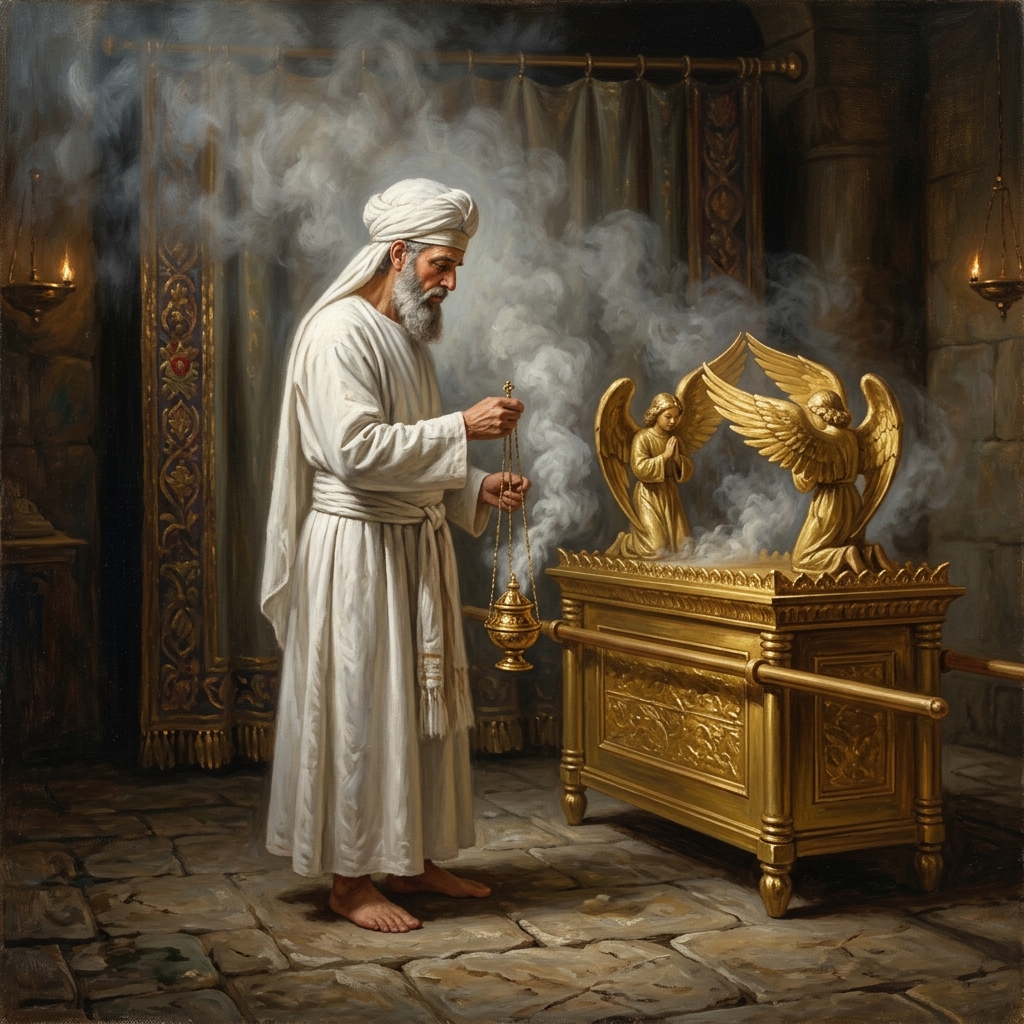
On the tenth day of the seventh month (Tishrei), ancient Israel came to a complete standstill. No work was performed, and the entire nation observed a strict fast. This was Yom Kippur—the Day of Atonement—the most sacred day on the Hebrew calendar. It was the only day of the entire year when the High Priest was permitted to pass through the thick veil into the Holy of Holies to stand before the unapproachable glory of God.
Understanding the rituals detailed in Leviticus 16 reveals the depth of Israel's sacrificial system and provides the essential background for understanding the Epistle to the Hebrews and the death of Jesus Christ.
The Rituals of Leviticus 16
The High Priest's duties on Yom Kippur were physically and spiritually demanding. Before performing the rituals, the High Priest stripped off his elaborate, golden royal vestments and dressed in simple, pure white linen garments, symbolizing extreme humility and purity before Yahweh.
The ritual required three distinct sacrifices:
- A Bull for the High Priest: The High Priest sacrificed a bull to make atonement for his own sins and the sins of his priestly household before he could intercede for the nation.
- The Sacrificial Goat: Two identical male goats were chosen for the sin offering of the nation. Lots were cast over them. The first goat was slaughtered, and its blood was brought into the Holy of Holies and sprinkled directly onto the Mercy Seat atop the Ark of the Covenant.
- The Scapegoat (Azazel): Over the second live goat, the High Priest laid both hands upon its head and confessed all the sins and transgressions of Israel. The goat was then led out into the uninhabited desert wilderness, symbolically carrying away the nation's guilt forever.
The Dual Symbolism: Propitiation and Expiation
The two goats of Yom Kippur illustrated two complementary aspects of salvation:
- Propitiation (The Slain Goat): Satisfying the holy justice of God through the shedding of innocent blood.
- Expiation (The Scapegoat): Physically removing the guilt and stain of sin far away from the community (Psalm 103:12: "As far as the east is from the west, so far has he removed our transgressions from us").
The New Testament Fulfillment
The Epistle to the Hebrews explicitly identifies Jesus as both the ultimate High Priest and the perfect sacrifice. Unlike the earthly High Priests who had to offer repeated sacrifices year after year for their own sins, Jesus was sinless. He entered the heavenly Holy of Holies not with the blood of goats and calves, but with his own blood, obtaining eternal redemption (Hebrews 9:11-14).
When Jesus died on the cross outside the city walls of Jerusalem, he fulfilled the role of both goats—shedding his blood to satisfy divine justice and carrying the sins of the world far away into the wilderness of death.