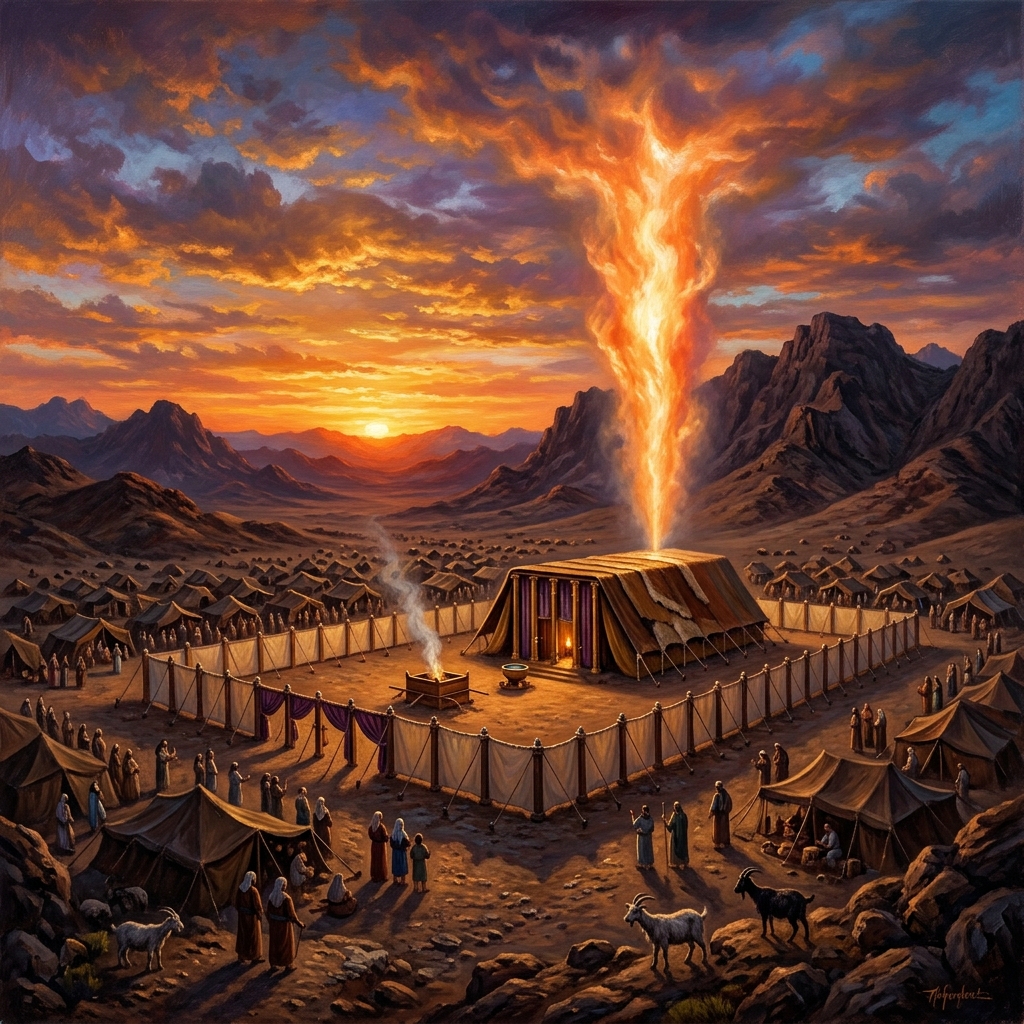
Following the Exodus from Egypt, God did not leave the Israelites to wander the desert alone. At Mount Sinai, God gave Moses detailed instructions for constructing a sacred, portable sanctuary known as the Tabernacle (*Mishkan*, meaning "dwelling place"). For nearly 500 years—from Sinai until King Solomon dedicated the First Temple in Jerusalem—the Tabernacle served as the spiritual and physical center of Israelite worship.
Understanding the layout, furniture, and sacrificial rituals of the wilderness Tabernacle reveals how ancient Israel related to a holy God, and how every element of the Tabernacle prefigured the ministry of Jesus Christ.
The Layout of the Tabernacle Complex
The Tabernacle was designed to be easily disassembled, transported, and reassembled as Israel journeyed through the wilderness. Surrounded by a white linen fence (150 feet long by 75 feet wide), the complex was divided into three distinct zones of increasing holiness:
- The Outer Court: Accessible to any ritually clean Israelite. It contained the Bronze Altar (where animal sacrifices were offered) and the Bronze Laver (where priests washed before serving).
- The Holy Place: A tented structure accessible only to consecrated priests. It housed three sacred items: the Golden Lampstand (*Menorah*), the Table of Showbread, and the Altar of Incense.
- The Holy of Holies (Most Holy Place): An inner sanctuary separated by a thick veil, representing the unapproachable presence of God. It contained only one item: the Ark of the Covenant.
The Sacred Furniture and Its Symbolism
Every piece of furniture inside the Tabernacle carried rich theological meaning:
- The Bronze Altar: Where blood sacrifices were offered for sin, teaching Israel that atonement requires a substitutionary sacrifice.
- The Golden Lampstand: Fueled by pure olive oil, providing continuous light in the Holy Place, symbolizing God's life-giving presence.
- The Table of Showbread: Holding 12 loaves of bread representing the 12 tribes of Israel, symbolizing God's covenantal provision.
- The Altar of Incense: Situated directly in front of the veil, burning sweet incense daily, symbolizing the prayers of the saints ascending to God.
- The Ark of the Covenant: A gold-acacia chest holding the Ten Commandments, Aaron's rod, and a jar of manna. Atop the Ark sat the Mercy Seat (*Kapporet*), flanked by two cherubim, where God's glory (*Shekinah*) dwelt.
The Tabernacle Fulfillment in the New Testament
In the Gospel of John, the apostle writes, "The Word became flesh and dwelt (*eskenosen*, literally 'tabernacled') among us" (John 1:14). Jesus is presented as the ultimate Tabernacle—the physical place where God's glory visibly dwelt among humanity.
Furthermore, the Epistle to the Hebrews explains that the wilderness Tabernacle was an earthly copy of the true heavenly sanctuary (Hebrews 8:1-6). When Jesus died on the cross, the thick Temple veil separating humanity from the Holy of Holies tore in two from top to bottom (Matthew 27:51), demonstrating that through Christ's death, believers now have direct access to the presence of God.