1 Step 1: Opening Prayer (1 Min)
Leader Focus: Pray that group members will grasp the radical, transforming nature of saving faith—how God extends grace to unlikely outsiders who revere His Name above earthly allegiances.
2 Step 2: Scripture Reading (3 Mins)
Scripture Passage: Joshua 2:1–24; 6:22–25
3 Step 3: Guided Observations (5 Mins)
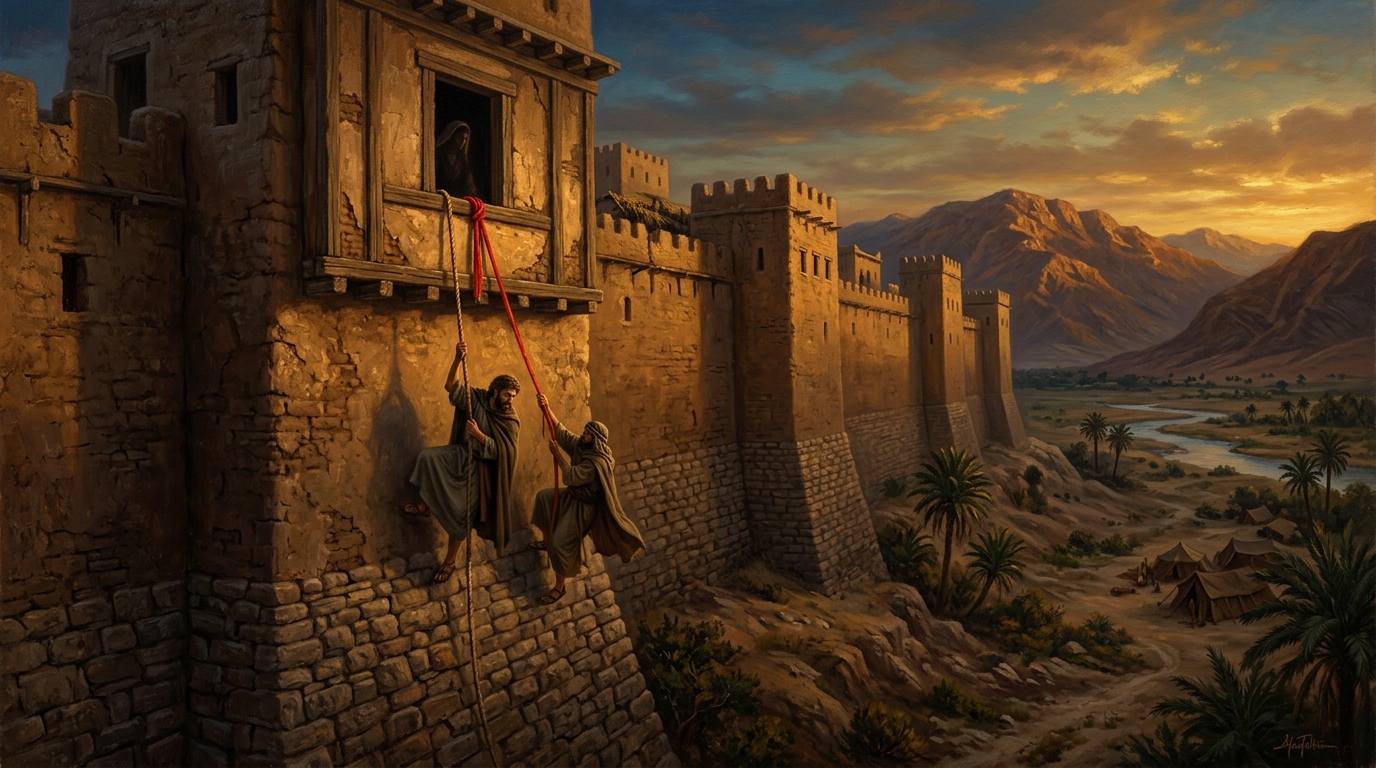
In Joshua 2, Joshua sends two spies secretly from Shittim to scout the Promised Land, especially the fortified border fortress of Jericho. They lodge at the house of Rahab, an innkeeper whose residence was built directly into the outer city wall. When the king of Jericho seeks their arrest, Rahab hides them under stalks of flax laid out on her flat roof and misdirects the searchers. She then ascends the roof and delivers one of the most magnificent confessions of faith in the Old Testament: she testifies that terror has fallen on the inhabitants because of how Yahweh dried up the Red Sea forty years prior and destroyed the Amorite kings Sihon and Og. She confesses: 'For Yahweh your God, He is God in heaven above and on earth beneath' (v. 11). Rahab extracts a solemn sworn oath from the spies that, because she showed them kindness (hesed), they will deal kindly with her and preserve her father, mother, brothers, sisters, and all they have. The spies agree under three conditions: she must not disclose their mission, all her family must remain inside her home, and she must tie the scarlet cord (tiqvat chut hashani) through the window by which she lowered them. In Joshua 6:22–25, when the walls of Jericho collapse, Joshua commands the two spies to bring Rahab and her family out safely; her family is fully preserved, and she dwells among Israel to this day.
- What reports had reached Jericho, and how had the Canaanites emotionally responded to the news of Yahweh's mighty acts (Joshua 2:9–11)?
- What terms of agreement and identifying sign did the spies establish with Rahab to guarantee her household's deliverance (Joshua 2:12–21)?
- How does Joshua 6:22–25 demonstrate the absolute faithfulness of God and Joshua to an oath made in Yahweh's Name?
4 Step 4: Historical & Cultural Context (6 Mins)
To understand the depth of Joshua 2, we must look at the archaeological and cultural setting of ancient Jericho (Tell es-Sultan). Situated in the fertile Jordan River valley approximately 800 feet below sea level, Jericho was a heavily fortified border fortress guarding the eastern approach into the central highlands of Canaan. Ancient cities of this period often possessed double-rampart defensive systems: a massive stone revetment wall at the base of an embankment topped by a mudbrick parapet, with domestic dwellings constructed directly against or spanning the gap between the fortifications. Living literally in the wall positioned Rahab's house with a window overlooking the outside slope—an ideal architectural location for lowering fugitives beyond the city gate.
Rahab is described as a zonah—traditionally translated as a harlot or innkeeper. In the ancient Near East, roadside establishments and lodging houses served traveling caravans, merchants, and foreign emissaries. Such establishments placed their proprietors at the crossroads of regional information. Rahab had overheard reports from merchants, messengers, and traders traveling across the Jordan. Yet while the entire city of Jericho succumbed to paralyzing dread (their hearts 'melted,' namas), Rahab alone drew a theological conclusion.
Her confession in verse 11 is breathtaking: 'For Yahweh your God, He is God in heaven above and on earth beneath.' These exact words mirror Moses' exalted monotheistic declaration in Deuteronomy 4:39. A pagan Canaanite woman, raised in polytheistic idolatry, recognized what Israel's wilderness spies forty years earlier had doubted: that Yahweh is not a mere territorial tribal deity, but the sovereign Ruler over all cosmic realms.
Rahab acts upon this faith by appealing to hesed (covenant loyalty and steadfast love). She had demonstrated hesed by shielding Yahweh's messengers at the risk of her own execution for treason; in return, she requests reciprocal hesed backed by an ot emet ('sure token' or 'sign of truth'). The spies seal the agreement with a mutual oath sworn under penalty of death ('our life for yours').
The identifying sign chosen was the scarlet cord (tiqvat chut hashani) bound in her window. In Hebrew, tiqvat carries a compelling double meaning: it is both a physical 'cord' or 'thread,' and the foundational Hebrew noun for 'hope' or 'expectation' (from the root qavah). The bright crimson cord hung outside her wall functioned as a visual token of sanctuary—deliberately recalling the blood of the Passover lamb painted upon the doorposts of Israel's houses in Exodus 12. Just as the destroying angel passed over houses bearing the blood of the lamb, the army of Israel passed over the household marked by the scarlet thread.
The New Testament highlights Rahab as a towering exemplar of redemption and grace:
- Hebrews 11:31 enshrines her in the Hall of Faith: 'By faith the prostitute Rahab did not perish with those who were disobedient, because she had given a friendly welcome to the spies.'
- James 2:25 cites her as proof of living, active faith: her belief was not passive theological theory, but costly obedience that proved its reality through action.
- Matthew 1:5 includes Rahab by name in the royal genealogy of Jesus Christ as the mother of Boaz and great-great-grandmother of King David!
Rahab's story stands as an enduring monument that God's covenant mercy is never restricted by past sin, ethnicity, or pagan heritage—whoever calls upon Yahweh in true faith is rescued, redeemed, and given an eternal inheritance among God's people.
5 Step 5: Timeless Truth Bridge (3 Mins)
- True Faith Moves from Hearing to Active Trust: While all Jericho trembled in fear of God's power, only Rahab turned that fear into covenant loyalty and surrender. Genuine faith is not mere intellectual awareness of God, but active allegiance.
- God's Grace Transcends Every Human Boundary: No background, moral failure, or social stigma places a person beyond the reach of divine mercy; God delights to redeem outsiders and weave them into His sovereign redemptive plan.
- Redemption Demands a Visible Refuge: Just as Rahab's family was safe only beneath the scarlet cord within the appointed house, our eternal salvation rests solely in the shelter of Christ's redeeming blood.
6 Step 6: Personal Application (4 Mins)
- Reflect: In what area of your life is God calling you to step out in courageous faith rather than conforming to surrounding cultural fears or pressures?
- Action Step: Write down 1 practical step of faith for this upcoming week. (Example: 'Like Rahab reaching out for her entire family, I will intentionally pray for and initiate an encouraging spiritual conversation with a family member or friend who does not yet know the Lord.')
7 Step 7: Closing Prayer (1 Min)
Leader Focus: Pray that each person will possess the fearless, obedient faith of Rahab, trusting God's steadfast love and extending His redeeming grace to others.
Group Discussion & Q&A Prompts (10–15 Mins)
- Why do you think the rest of Jericho remained hardened in rebellion despite hearing of God's mighty acts, while Rahab turned in faith?
- How does Rahab's request for her father, mother, and siblings challenge our responsibility to intercede for and invite our loved ones into God's refuge?
- What does Rahab's inclusion in the genealogy of Jesus (Matthew 1:5) teach us about God's heart for outsiders and the nature of His grace?