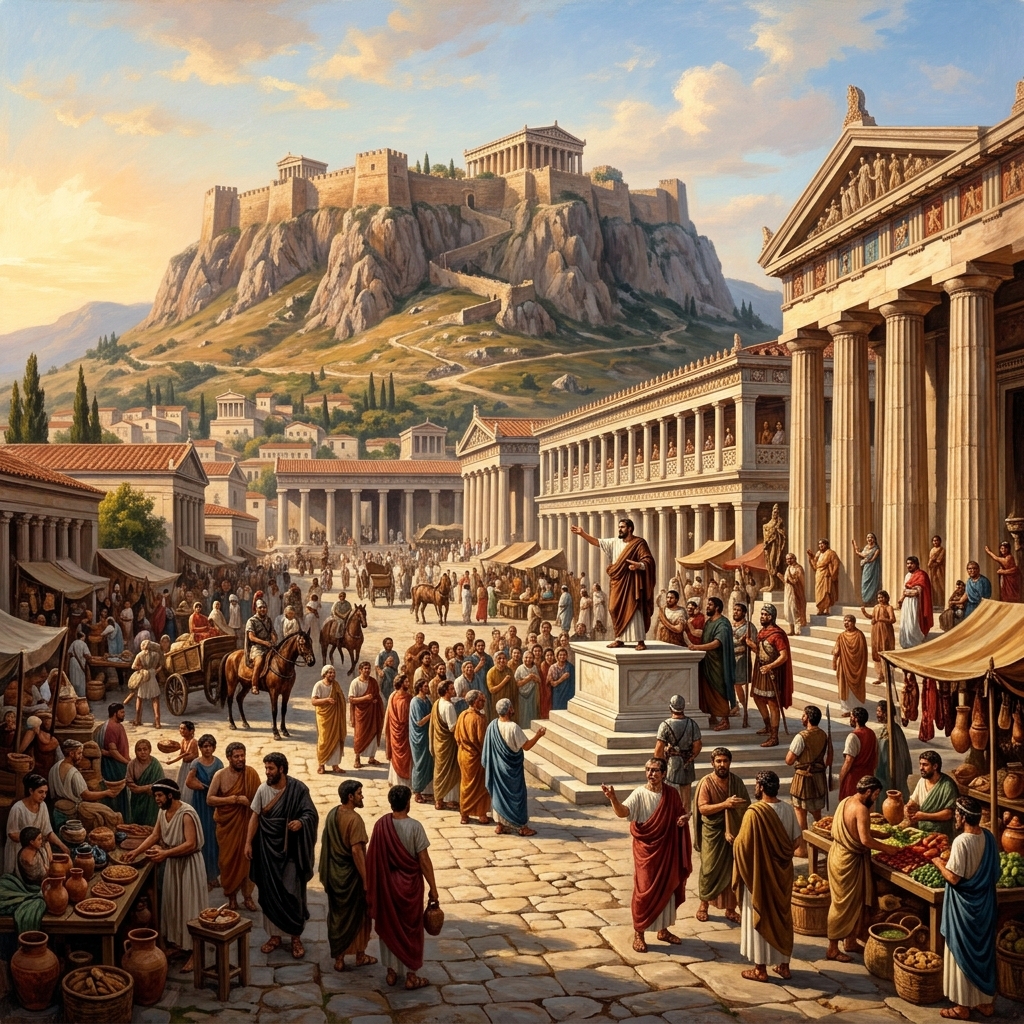
When the Apostle Paul arrived in Corinth around AD 50, he stepped into one of the most vibrant, wealthy, and morally chaotic cities in the Roman Empire. Situated on a narrow neck of land connecting northern Greece with the Peloponnese peninsula, Corinth commanded two major seaports. Ships routinely dragged their cargoes across the Isthmus to avoid treacherous sea voyages around the southern capes, turning Corinth into a colossal commercial nerve center.
To read 1 and 2 Corinthians without understanding ancient Corinthian culture is to miss the fierce pressures facing early Christians. From Isthmian athletic games to pagan temple banquets, Corinth's social dynamics explain virtually every conflict Paul addressed in his epistles.
The Boomtown Economy and Social Mobility
Destroyed by Rome in 146 BC, Corinth was refounded by Julius Caesar in 44 BC as a Roman colony. Unlike ancient aristocratic cities like Athens, Corinth was populated largely by freed slaves, Roman veterans, ambitious merchants, and international traders. It was an ancient "boomtown" where anyone could strike it rich through trade, maritime shipping, or bronze manufacturing.
This environment fostered intense individualism and social rivalry. Wealthy citizens flaunted their status by sponsoring public feasts, purchasing prestige, and taking one another to civil courts (a practice Paul sharply condemned in 1 Corinthians 6). Status anxiety permeated the young church, leading to divisions between wealthy believers who arrived early to the Lord's Supper and poor laborers who arrived late and hungry (1 Corinthians 11:17-34).
Pagan Religion and the Temple of Aphrodite
Corinth was dominated by pagan religion. Overlooking the city stood the Acrocorinth, a steep mountain topped by the famous Temple of Aphrodite, the goddess of love and beauty. Ancient writers recorded that the temple housed hundreds of sacred prostitutes. In the ancient world, the verb corinthianize meant to practice extreme sexual immorality.
Furthermore, meat sold in Corinthian markets was almost exclusively derived from animals sacrificed in pagan temples. This sparked an intense theological dilemma for early Christians: Could a believer eat meat offered to idols, or attend business banquets hosted in pagan temple dining rooms? Paul's nuanced response in 1 Corinthians 8-10 balanced Christian freedom with loving concern for weaker consciences.
The Bema Seat and Paul's Trial
Archaeology has brought the text of Acts directly to life in Corinth. In the center of the ancient Corinthian forum (agora), archaeologists uncovered the *Bema*—a elevated stone judgment platform where the Roman governor (proconsul) held official hearings.
Acts 18 records that hostile leaders dragged Paul before the proconsul Gallio at the Bema, accusing him of persuading people to worship God contrary to the law. Gallio dismissed the case as an internal Jewish dispute, providing Paul legal protection that allowed the Corinthian church to flourish. When Paul later wrote in 2 Corinthians 5:10 that "we must all appear before the judgment seat (*bema*) of Christ," his readers vividly pictured the solid stone platform in the middle of their own town square.
Athletic Imagery: The Isthmian Games
Every two years, Corinth hosted the Isthmian Games, second only to the Olympic Games in prestige. Athletes from across the empire gathered to compete in footraces, boxing, and chariot races, vying for a coveted crown woven of wild celery or pine leaves.
Paul utilized this local passion for sports to teach spiritual discipline. When he wrote, "Do you not know that in a race all the runners run, but only one gets the prize? ... They do it to get a crown that will not last, but we do it to get a crown that will last forever" (1 Corinthians 9:24-25), his audience could hear the roar of the crowds at the nearby Isthmian stadium.