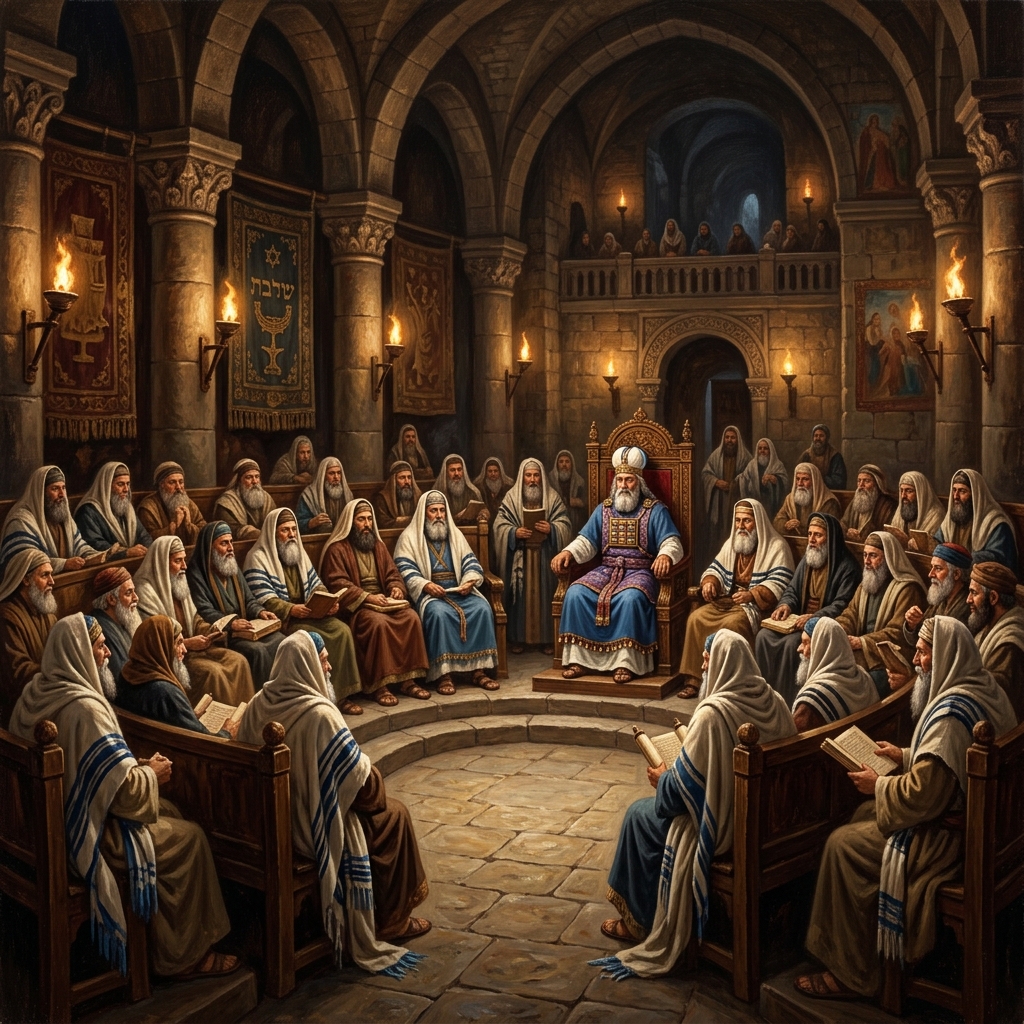
Throughout the Gospels and the Book of Acts, a powerful body of leaders constantly appears in conflict with Jesus and the early church: the Sanhedrin. Functioning as a supreme court, legislative assembly, and religious council all in one, the Sanhedrin was the most authoritative Jewish institution in first-century Judea. But how was it structured, what powers did it hold under Roman occupation, and why did it play such a central role in the trial of Christ?
Structure and Composition of the Council
The term "Sanhedrin" comes from the Greek word synedrion, meaning "assembly" or "sitting together." The Great Sanhedrin in Jerusalem consisted of 71 members, modeled after the 70 elders appointed by Moses in the wilderness plus Moses himself (Numbers 11:16). The council was presided over by the reigning Jewish High Priest.
The council was composed of three primary groups:
- The High Priests and Aristocrats: Dominated by the Sadducees, who controlled the Temple wealth and political relations with Rome.
- The Scribes and Legal Experts: Mostly Pharisees, who held deep influence among the common people due to their mastery of the written Torah and oral traditions.
- The Elders: Tribal heads and respected community leaders representing wealthy Judean families.
Authority and Limits Under Roman Rule
Under the Roman governor system, Rome granted local religious autonomy to subject populations. The Sanhedrin had jurisdiction over religious law, Temple management, civil disputes, and criminal offenses among Jews. They commanded their own police force—the Temple Guard—and could arrest suspects anywhere in Judea.
However, Rome strictly retained the ius gladii (the "right of the sword"). While the Sanhedrin could try blasphemy and sentence offenders to corporal punishment, they were legally barred from carrying out capital punishment without the Roman governor's explicit ratification. This legal limitation explains why the council had to bring Jesus before Pontius Pilate rather than executing him directly under Jewish law.
The Trial of Jesus: Legal Irregularities
The Gospel accounts of Jesus' trial before the Sanhedrin highlight numerous violations of established Jewish legal procedure (as recorded in the Mishnaic tractate Sanhedrin):
- Nighttime Proceedings: Capital trials were strictly forbidden from taking place at night or on the eve of a festival.
- Unanimous Verdict Suspicion: Under Jewish law, if a council voted unanimously to condemn a suspect to death without any member speaking in defense, the verdict was considered invalid due to suspicion of conspiracy.
- Location: Official capital trials had to occur in the Chamber of Hewn Stone in the Temple complex, not in the private residence of the High Priest (Caiaphas).
The Sanhedrin in the Book of Acts
Following the resurrection, the Sanhedrin repeatedly summoned the apostles, including Peter, John, and Paul. Notably, not all council members were hostile; Gamaliel, a highly respected Pharisee, famously advised the council to refrain from executing the apostles, arguing that if their movement was of human origin it would fail, but if it was of God, no human council could stop it (Acts 5:34-39).
The Great Sanhedrin continued to operate until the destruction of Jerusalem by the Romans in AD 70. Following the destruction of the Temple, the council relocated to Javneh, laying the foundation for modern Rabbinic Judaism.