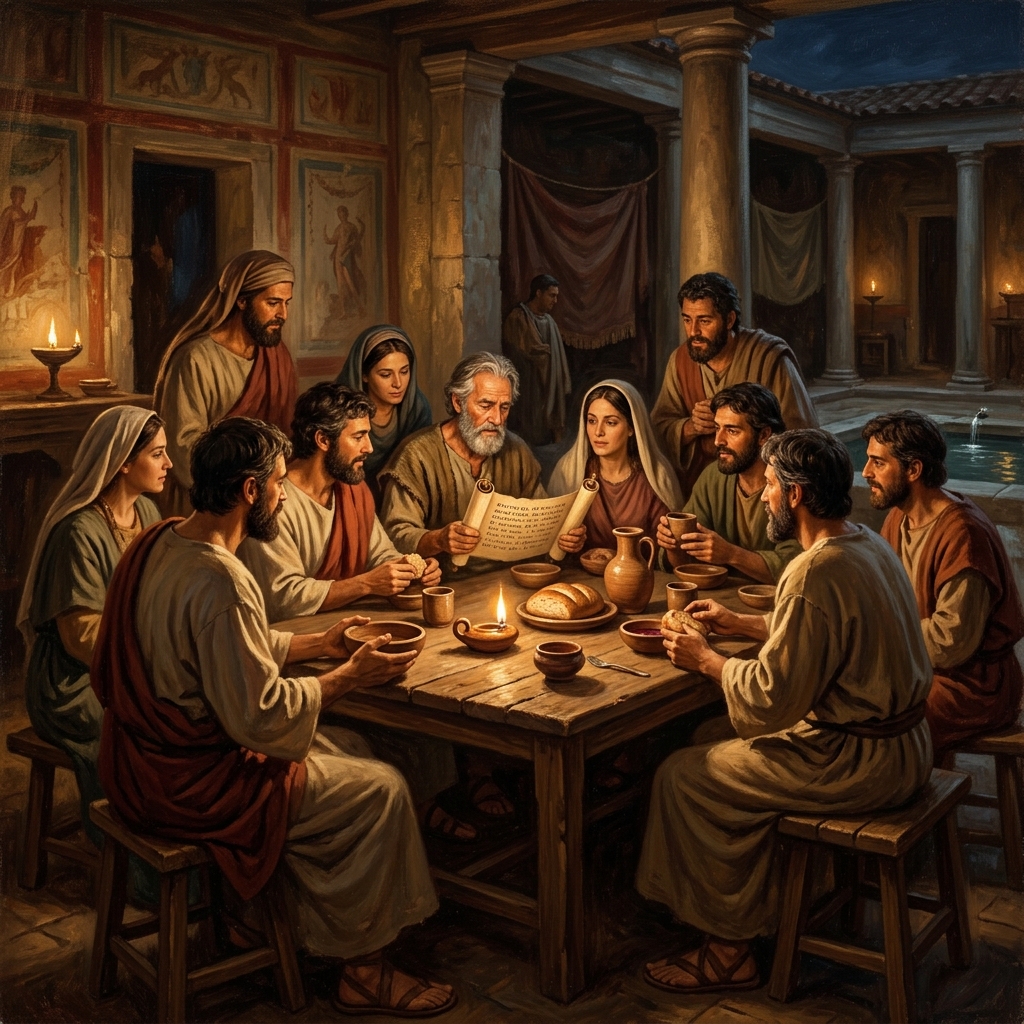
When modern believers think of a church, they imagine a dedicated building with a steeple, sanctuary, and pews. However, for the first three centuries of Christian history, dedicated church buildings simply did not exist. From the day of Pentecost until the Edict of Milan in AD 313, the early Christian movement gathered almost exclusively in private homes (*domus ecclesiae*).
Understanding how house churches functioned in the Greco-Roman world illuminates why the early church experienced such explosive growth, how leadership was structured, and what true Christian community looked like in the ancient world.
The Roman Household Structure
In the Greco-Roman world, a household (*oikos*) was far larger than a modern nuclear family. A wealthy Greco-Roman household included extended family members, slaves, freedmen, domestic servants, and business clients. When a head of a household converted to Christianity—such as Cornelius (Acts 10), Lydia (Acts 16), or Philemon (Philemon 1:2)—the entire household was baptized and integrated into the church.
Wealthier believers who possessed spacious homes (*atrium* or *triclinium* houses) hosted the local congregation. For example, Paul greets "Priscilla and Aquila and the church that meets in their house" (Romans 16:3-5). An average wealthy Roman villa could accommodate between 30 and 50 people for a gathering, making the early church a network of small, intimate relational cells scattered across cities like Rome, Corinth, and Ephesus.
What First-Century Worship Looked Like
Gatherings in early house churches were intensely participatory and informal compared to modern corporate services. Based on New Testament passages such as 1 Corinthians 14:26 and Acts 2:42, a typical house church gathering centered on four primary elements:
- The Agape Feast (Love Feast): Early Christians did not merely take a tiny cup and wafer; they shared a full communal meal (*agape* feast). Wealthy and poor, masters and slaves sat at the same table, shattering strict Greco-Roman social hierarchies.
- Teaching and Reading of Letters: Apostles' letters (such as Paul's epistles) and the Gospels were read aloud to the entire household. Because books were rare and expensive manuscripts, oral reading was essential.
- Singing and Shared Contributions: Members contributed psalms, hymns, spiritual songs, testimonies, and spiritual gifts for mutual encouragement.
- Financial Hospitality and Support: Offerings were collected specifically to care for local widows, orphans, prisoners, and itinerant missionaries.
The Archaeology of Early House Churches
Archaeology has confirmed the Biblical model of early Christian house worship. The most famous example is the **Dura-Europos house church** in modern Syria, dated to AD 232. Archaeologists discovered a standard residential home that had been modified for Christian worship by knocking down a interior wall to create a larger assembly room capable of holding 50 people, complete with a dedicated baptistery decorated with early frescoes of Christ.
Why the House Church Model Was Unstoppable
The house church structure was ideal for surviving imperial persecution. Because Christians possessed no public buildings, Roman authorities could not easily confiscate their property or shut down their meetings. If persecution erupted in one neighborhood, believers simply met in different homes across the city.
Furthermore, meeting in homes fostered radical hospitality, deep accountability, and rapid multiplication. By remaining small, relational, and adaptable, the early church conquered the Roman Empire from the inside out.